
Where Does Your Attention Go When You Scroll? Bloomscrolling, Doomscrolling and the Sound You Turn Off
The latest trend in your social media feed? #Bloomscrolling
Bloomscrolling: purposefully seeding your social media feed with positive, uplifting content.
Turns out, I’ve been bloomscrolling for years and never knew. (You too?)
See, I’m a private person, and in all transparency, I’m hypersensitive to social media.
Truthfully, I hate social media. Generally.
Granted, hate is a strong word, but it satisfies the overarching lackluster zeal and distaste I carry for that folder on my iPhone home screen where all the little social icons live safely tucked away.
Prime example? I was on set filming the movie No Postage Necessary, when fellow actor Mike Beach asked me for my IG handle. I replied, “what’s a handle?” Pretty sure he just about swallowed his tongue.
Now, I use social media for business (albeit begrudgingly) and I have to be genuinely excited about something before I’ll post. When I do look at my feed, I don’t want things that make me cringe, question humanity, or try to rile heated emotions in me.
Just like IRL, I seek to cultivate a space of calm inside me, especially when I’m creating.
Not gonna lie: it’s really cool that the internet finally gave the habit a name and a hashtag.
Australian speaker Lucy Bloom gave the idea its name in 2025, after building a fresh Instagram account that followed only art, and this year “bloomscrolling” made it onto Good Morning America.
The new word does raise an old question: when we scroll, where do we put our attention?
And if you’ve been wondering how to stop doomscrolling, the answer might start with your ears.
What bloomscrolling gets right… and what it leaves out
Bloomscrolling means filling your feed on purpose with things that lift you: art, nature, kindness, people making beautiful things. It’s an answer to doomscrolling, the habit of scrolling through bad news long after it stops being useful.
And doomscrolling does keep poor company. A review published September 2026 pooled 44 studies and found doomscrolling linked with anxiety, depression and psychological distress. (I could have told them that.)
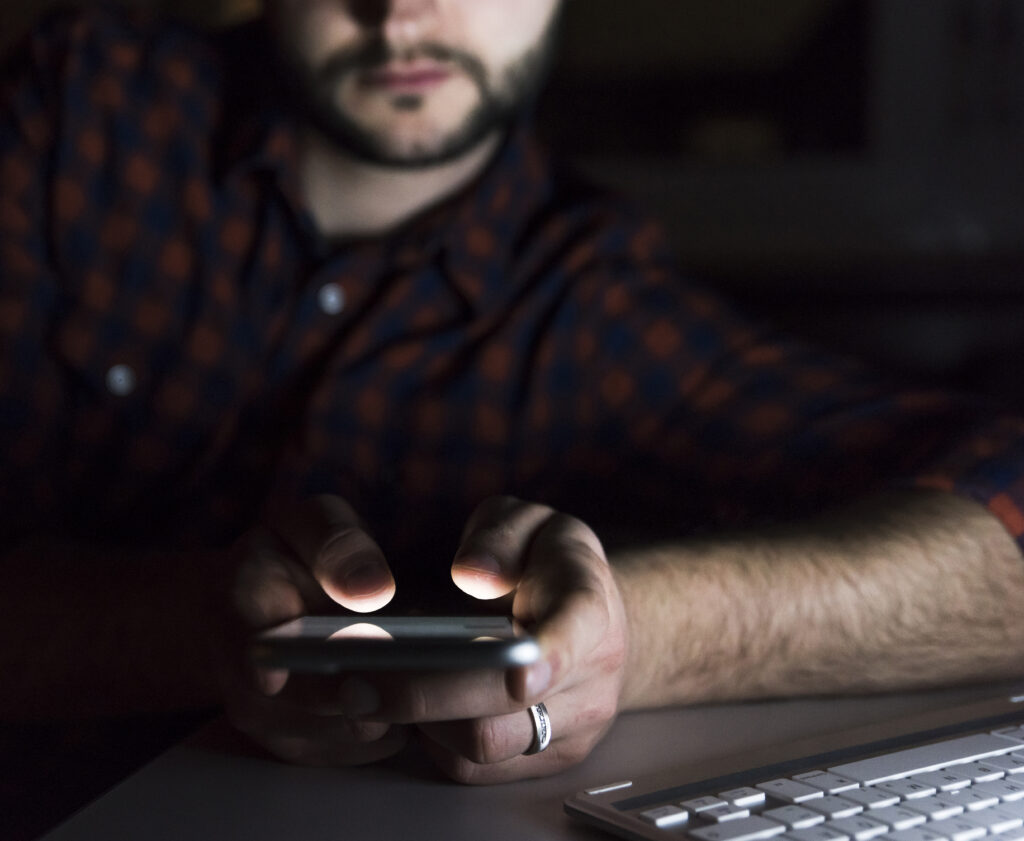
The authors are careful to add that most of those studies capture a single moment, the certainty is very low, and nobody can yet say which comes first, the scrolling or the distress. (Still…)
Newcomer on the social scene, bloomscrolling has never been tested. However, the nearest evidence is encouraging.
In a 2025 trial, 68 people living with long COVID were randomly split into two groups. One group joined four weekly online sessions that taught a simple way to find awe in ordinary life: give something your full, undivided attention, slow down, then exhale and let the feeling expand. The practice took under 30 seconds, three times a day. The other group waited four weeks before starting.
After those four weeks, the awe group reported less stress, fewer depressive symptoms and greater well-being; their anxiety didn’t change.
Awe is real, and it starts with full attention.
But awe is a mixed bag. Psychologists describe it as what we feel in the presence of something vast that we can’t quite take in, and it can carry fear as well as wonder.
(Sounds a lot like my social media algorithm.)
On a feed, awe can also tip into something else: comparison. We see a breathtaking painting or a flawless performance, and instead of wonder, we feel a lingering doubt that we could ever make something so magnificent ourselves. Research backs this up: in a 2014 study, people who used Facebook most had lower self-esteem, and seeing profiles of people who seemed better off lowered it on the spot.
We tend to measure our own worth by how well we can replicate, create or perform what someone else does.
A sad, but honest assessment of the human condition (myself included).
Here’s what the bloomscrolling trend leaves out.
A prettier feed is still a feed. The question is, how much of you is there while you doomscroll through it?
And even when you’re fully there, pleasant isn’t the same as calm. Psychologists have long separated two dimensions of feeling: whether something is pleasant or unpleasant, and whether it calms you or stirs you up (James Russell mapped them in 1980). For instance, a joyful, fast-cut reel or TikTok is pleasant and stimulating at the same time.
For me, creativity has always been a delicate dance between uplifting inspiration and grounded physical expression. A feed full of lovely things can give you the first and still leave you without the second. Or, at least, set us up to feel awe about what we’ve seen and lingering doubt that we’d be able to make something so magnificent ourselves.
One foot in each world
Notice how most people watch their feeds: sound off, captions on. In the waiting room before the doctor calls your name. On the bus, so you don’t have to talk to the person beside you. In the kitchen, while you wait for a text to come through.
One foot in the virtual world, the other in real life.

That in-between state is the part that interests me most. You’re not fully in the physical, and you’re not fully in the virtual either.
So, where are you?
The writer Linda Stone named this posture in 1998: continuous partial attention, scanning everything so you don’t miss anything, and never quite landing anywhere. Basically, FOMO before it became a hashtag.
Research has since put numbers to the cost of being elsewhere.
In 2010, Harvard psychologists Matthew Killingsworth and Daniel Gilbert used an iPhone app to check in on 2,250 people at random moments of their days. Almost half the time, participants’ minds were somewhere other than on their current task. And, when distracted, participants reported feeling less happy than when their minds were on what they were doing.
A divided mind, it turns out, is an unhappier one.
A 2025 study of 188 college students gave the phone’s side of this a name: “online vigilance,” or that pull in the back of your mind toward the online world, even when your phone is in your pocket. The students who felt that pull most spent more time on social apps (their iPhones kept count), and their minds wandered off more often without their meaning to. (Where did those minds go? The researchers don’t know yet. That’s their next question.)
Many of us feel pulled out of our physical lives and into our virtual personas.
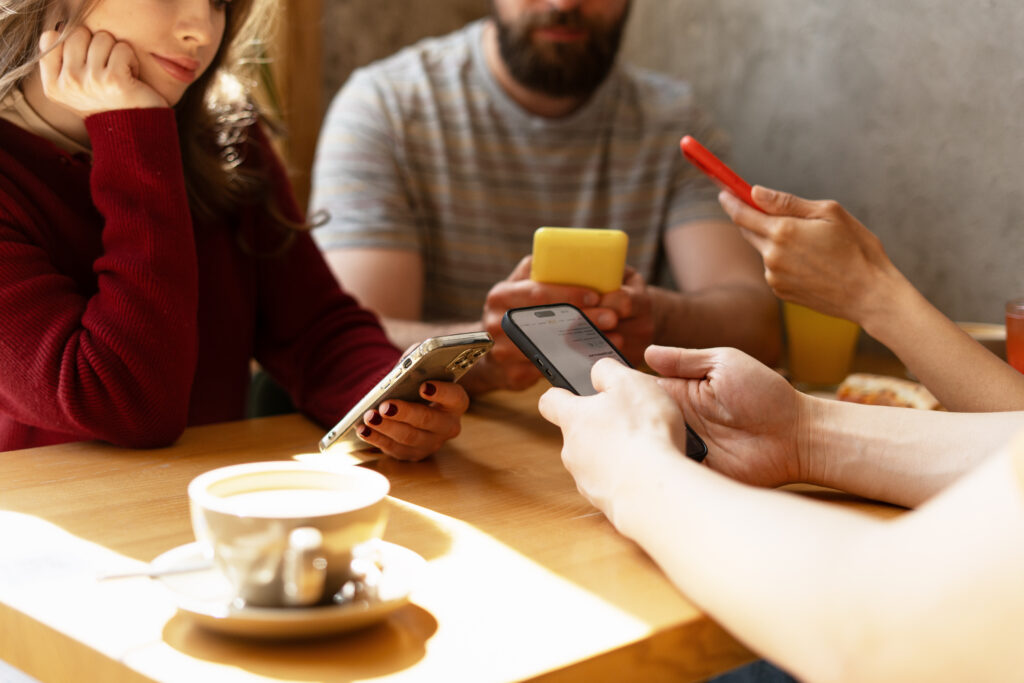
The room pays for it too. In a 2018 study, psychologists Ryan Dwyer, Kostadin Kushlev and Elizabeth Dunn sent more than 300 people out to share a restaurant meal with friends or family, and randomly asked some of them to keep their phones on the table. With phones present on the table, diners felt more distracted and enjoyed the meal less.
In other words, the half of you that’s somewhere else costs you the moment you’re actually in.
What you lose when you turn the sound off
I think part of why we watch on mute is that sound makes a world more fully immersive.
When the sound is on, the world on the screen feels more real. I wrote about this in Why Do People Like Horror Movies?: a scene is never as frightening with the volume down.
Virtual-reality researchers have measured the same thing in gentler settings. In two 2020 experiments, with about 40 people each walking through a virtual park, adding a nature soundscape made people feel more like they were actually there in the park.
Of course, most of the time we mute for practical reasons: there are other people around, we’re trying not to distract, we’re trying not to get caught. Consider what the mute button takes away. Captions kidnap the words. And the words lose a voice: its pace, its warmth, its rise and fall, the breath between phrases, and any music underneath.
Mute rips out the heart of sound.
In a major 2003 review, psychologists Patrik Juslin and Petri Laukka showed that speech and music carry emotion through the same acoustic cues: speed, loudness, pitch and tone color.
Read the captions, and you get the words without the intent and emotional music they were birthed from.
That music — the sound of words — matters more than we think.
In a 2012 study, 68 girls aged 7 to 12 went through a stressful test, then got in touch with their mothers. Girls who heard their mother’s voice, either in person or over the phone, had lower levels of the stress hormone cortisol and released oxytocin, a hormone linked to bonding. Girls who sent their mothers instant messages looked just like girls who had no contact at all.
The researchers concluded that the comforting sound of a familiar voice made the difference.

It’s one small study, and a whole generation has learned to text since then. But in 2025, a study of 348 young women, people who grew up texting, found the same pattern without the hormone tests: support from a close friend by voice call or video landed about as well as support in person, and support by text landed lower. (Read that again.)
The same kind words, delivered without a voice, did less.
A feed has no cadence
Music resolves. A cadence, or a progression of harmonies that makes the end of a phrase, gives a sense of resolution. Music tells you when it’s safe to let go.
A social media feed never ends: you keep scrolling, waiting for a resolution that, ultimately, never comes. It’s how five minutes becomes two hours.
Musicians have a word for what a good note does after it’s played: it blooms. The tone opens after the first strike as its overtones gather, then settles and slowly fades into silence.
A crystal bowl is the clearest example I know: the strike, the swell, the long shimmer thinning to nothing.
That’s the part bloomscrolling skips. A flower doesn’t bloom at scrolling speed, and neither does a musical note.
What happens when people step out of the feed
Some of the strongest recent evidence comes from people who stepped away from the scroll.
In a 2025 trial, researchers asked 467 adults to block all internet access on their phones for two weeks; they could still call and text. (I know, earth-shattering.)
On average, the group asked to block internet on their phones showed better mental health, greater well-being and a measurably better ability to sustain attention, a change the researchers compare to reversing about ten years of age-related decline in attention. Part of the benefit seemed to come from how people spent the time they got back: more time with people in person, more exercise, more time in nature.
There’s a catch. Keeping the block was hard. Of the 467 who signed up, only 119 kept it running for at least 10 of the 14 days. That tells you something about how strong the pull is.
The good news is that you don’t need to lock your phone to begin. You can start with one social media post.
How to stop doomscrolling: start with one sound
Sounds that ask you to pause, even if for a brief moment, are a good place to begin.
A 2024 review of the research found that natural sounds lowered heart rate, blood pressure and breathing rate more than quiet did, even though people didn’t report feeling less stressed. Slower breathing may account for some of the change in heart rate. Treat it as a pleasant possibility rather than a prescription.
Still, nature sounds good.
Try this: Sound On, Pick One Post.
Pick one post. Turn the sound on, with headphones if you’re around other people. Turn off outside distractions or notifications.
Choose a sound that asks you to pause and listen: birdsong, a slow piece of music, a single held note (like a crystal singing bowl), a person speaking at an easy, natural pace.
Stay listening to that sound until the very end… until the sound is completely gone.
When it’s over, give yourself a cadence of sorts: put the phone down for a minute, and let the ‘phrase’ end. (The frame around a sound changes what it does; I explore why in Healing Rituals.)
Then, notice. Do you feel more or less present? Where in your body did you feel the sound? Did you want to swipe before it ended?
All those feelings you have are points of data you can use to better understand how sound affects your body.
If you want to go deeper: choose your world
The bigger question underneath all of this is why. Why am I choosing to be present in the virtual world right now instead of the physical one?
Or, put another way, why am I choosing not to be present where I am?
The next time you reach for your phone in a waiting room or on a bus, pause before you open the app and ask yourself:
- Is there pain in my body I’d rather not feel?
- Is there an emotion or a hurt I’m trying to take my mind off?
- Is this distracting me from anxiety I’m feeling right now?
- Does the distraction actually ease the pain or the anxiety, or does it add to it, because nothing gets resolved?
We use distraction for a reason.
If we can get really honest about what that reason is, we have more information, and information is power. Maybe it means you make a different choice, and put the phone away and listen to the room until you can name three sounds in it. Maybe it means you keep doing exactly what you were doing, but at least you know why.
Until we know why, we’re not fully experiencing and expressing our own lives in the world, virtual or otherwise.
If the anxiety under the scroll is heavy or constant, that’s worth talking through with someone you trust or a professional.
Attention is the one thing every feed asks for. Decide where your attention goes.
You’ve just practiced listening to one sound all the way to its end. If you’d like to know which sound you’re tuned to right now, the Signature Frequency Quiz takes about three minutes and ends with a track composed for your result. Listen with the sound on.
Questions people ask about doomscrolling and bloomscrolling
Start small. Pick one post, turn the sound on, close everything else, and stay with it until the sound is completely gone. Then put the phone down for a minute. To go deeper, pause before you open the app and ask yourself why you’re reaching for it.
Bloomscrolling means purposefully seeding your social media feed with positive, uplifting content: art, nature, kindness, people making beautiful things. Australian speaker Lucy Bloom gave the idea its name in 2025.
It hasn’t been tested directly yet. The nearest evidence is encouraging: in a 2025 trial, a simple daily practice of finding awe in ordinary life lowered stress and depressive symptoms in people with long COVID. But a prettier feed is still a feed, and how present you are while you scroll matters too.
A 2026 review of 44 studies linked doomscrolling with anxiety, depression and psychological distress. The authors rated the certainty as very low, and nobody can yet say which comes first, the scrolling or the distress.
It’s writer Linda Stone’s 1998 term for scanning everything so you don’t miss anything, and never quite landing anywhere.
Studies cited
- Bloom, 2025. The blog post that named bloomscrolling, after she rebuilt her Instagram around art. thelucybloom.com
- Castelo, Kushlev, Ward et al., 2025. Two weeks of blocked mobile internet improved sustained attention, mental health and well-being; many couldn’t keep the block. PNAS Nexus
- Dwyer, Kushlev & Dunn, 2018. Diners with phones on the table felt more distracted and enjoyed the meal less. Journal of Experimental Social Psychology
- Fan & Baharum, 2024. Natural sounds lowered heart rate, blood pressure and breathing rate more than quiet, with no change in felt stress. Stress
- Gordon, Stellar, Anderson, McNeil, Loew & Keltner, 2017. Awe has a threat-based side that carries fear and can lower well-being. Journal of Personality and Social Psychology
- Holtzman, Lisi, Godard & DeLongis, 2025. In 348 young women, support by voice or video landed about as well as in person; support by text landed lower. Psychological Reports
- Jones, Norville & Wunder, 2025. Students who felt a stronger pull toward the online world spent more time on social apps and had more unintended mind wandering. Psychological Reports
- Juslin & Laukka, 2003. Speech and music carry emotion through the same acoustic cues: speed, loudness, pitch and tone color. Psychological Bulletin
- Keltner & Haidt, 2003. Describes awe as the response to something vast that we can’t quite take in. Cognition and Emotion
- Kern & Ellermeier, 2020. In a virtual park, a nature soundscape made people feel more like they were really there. Frontiers in Robotics and AI
- Killingsworth & Gilbert, 2010. Phone check-ins with 2,250 people: minds wandered almost half the time, and wandering minds were less happy. Science
- Li & Yin, 2026. Across 44 studies, doomscrolling went with anxiety, depression and distress; certainty rated very low. Frontiers in Psychology
- Monroy, Amster, Eagle, Zerwas, Keltner & López, 2025. In 68 people with long COVID, a brief daily awe practice lowered stress and depressive symptoms compared with a waitlist; anxiety didn’t change. Scientific Reports
- Russell, 1980. Maps feeling on two dimensions: pleasant to unpleasant, and calm to stirred up. Journal of Personality and Social Psychology
- Seltzer, Prososki, Ziegler & Pollak, 2012. After a stress test, girls who heard their mother’s voice had lower cortisol; girls who messaged her looked like girls with no contact. Evolution and Human Behavior
- Stone, 1998. Coined “continuous partial attention” for scanning everything and never quite landing. Wikipedia
- Vogel, Rose, Roberts & Eckles, 2014. Heavier Facebook users had lower self-esteem, and upward-comparison profiles lowered it on the spot. Psychology of Popular Media Culture
Charleene Closshey
Charleene Closshey is a conservatory-trained musician, Billboard Top 40 artist and composer, and a PhD candidate in natural medicine. For four decades she studied what sound can do on a stage; now she measures what her compositions do inside the body: heart rate variability, sleep and brainwaves. She has performed on Broadway in the Tony Award–winning Once, starred in feature films, spoken at TEDx, and composed for film and stage. With one foot in the lab and one foot in the recording studio, she reads the research the way a musician listens: closely, and for what’s actually there.
About Charleene →
What does sound do inside a body?
Sound as wellness, with the research behind it. New articles in your inbox as they publish.